1.1: "And......Cut!"
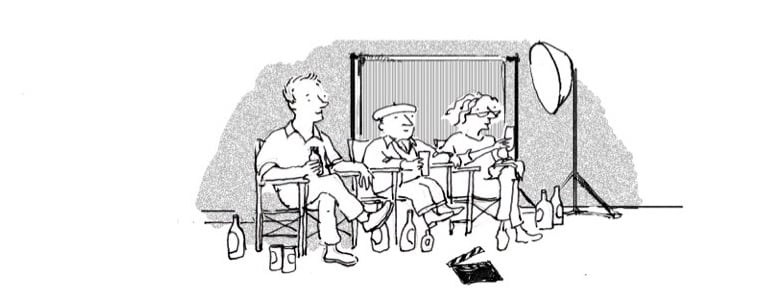
"…That's a wrap!" yelled The Director with a mixture of triumph and relief, marking the end of the day's shoot and the movie's final scene. The previously silent 'pub' burst into life as 'Alice' and 'George' relaxed, set aside their prop glasses, and shared a heartfelt hug across the table.
The sound engineer lowered the boom, the camerawoman took her eye from the viewfinder, and the grip put down the reflective sheet she'd been using to light the actors' faces. Four months of hard work had come to an end, and everyone was feeling a little euphoric.
"Great job, everyone!" called the Director, clapping his hands as he walked toward the actors. "I'm looking forward to having a drink tonight without that fucking dragon on my mind."
Alice and George were used to the old, unreconstructed director swearing. He did it a lot.
"Absolutely!" exclaimed the actor who'd been playing Alice. "I won't be thinking about the evils of capitalism for at least the next two weeks."
"Why's that?" asked the forty-something actor who'd been playing George, finally free from the problematic northern English accent he'd been wrestling with throughout the shoot.
"Well," explained Alice, "I'm giving a speech at the Just Stop Oil rally in Trafalgar Square in the first week of November."
"No rest for the woke-ed," chuckled the Director, patting her on the back, already anticipating that he'd be in the crowd that night to hear her speak.
‘George’ felt a little left out. His was a handsome, earnest face, usually seen in Hollywood blockbusters, but here he was playing against type.
He'd taken the male lead in this movie, quietly hoping for an Oscar or at least a BAFTA for his sympathetic portrayal of the conflicted consultant; a unique blend of kitchen-sink drama and corporate thriller with a lump of CGI thrown in for good measure. And if it helped raise awareness of the climate crisis, all the better, for the planet and his career.
White plastic cups were distributed, Prosecco was opened, and the extended crew gathered to celebrate the end of the shoot.
Half an hour and several bottles later, the crew returned to dismantle the set while the Director and his two leads continued to reflect on their completed work. They'd grappled with a complex script which, together with the challenge of working with an imaginary dragon, had created some difficult moments. But now it was over, they sensed it was both a job well done and worth doing.
There was a lull in the conversation, so Alice took a moment to check her watch. She'd promised her husband she'd be home by 7 o'clock to put her little ones to bed, and she'd been looking for a moment to respectfully say her
goodbyes. This she did with a kiss on each cheek for George and a vast, friendly hug from the Director, with whom she was bound to work again soon.
George could see the Director was in a relaxed and approachable mood, so this was surely the moment he'd been waiting for, to ask what had been on his mind since he'd first read the part. Until now, he'd avoided asking it for fear of looking superficial. Yet, through all that subsequent time, and even during the shoot, he hadn't found an appropriate moment.
After all, the Director was famously short-tempered, and George had no wish to get in his line of fire. And what if the gossip columnists got hold of it? He could see the headlines now: ACTION HERO IS AS DUMB AS HE LOOKS! So, he'd kept his concerns to himself and hoped his acting would carry him through.
"So, how are you feeling? Satisfied with how it's turned out?" he asked the Director tentatively, slipping out of character and returning to his easy Californian drawl. "Did you get what you wanted?"
The Director looked at George and warmly patted his shoulder. "Yes, I'm delighted, thank you. And you were outstanding."
"Great!" The relief visible on George’s face. "I should have asked you this earlier, but… what was it all about?"
Somewhat puzzled, the Director took a swig from his cup and asked, "What do you mean?" He had no idea the movie they'd just wrapped had gone entirely over George's head.
George took a deep breath, realising he'd now have to own up to his ignorance. The Director was a short, stocky figure with a strong Scottish accent. George reckoned he must now be in his early seventies, and over his long career, he'd developed a reputation for being difficult, standing up to the studios for better pay for his technicians and marching in solidarity at the Iraq War, anti-Trump demos, and more recently, Gaza.
So, little wonder George found him somewhat intimidating. Moreover, George and the Director had discussed the script every day for the past six weeks and met on set for a solid month to shoot it. So, for George to admit he hadn't grasped the movie's underlying message was, frankly, terrifying.
For a moment, the Director was unsure how to respond. However, rather than anger, a depressing sense of defeat seeped into him. He'd always known that George wasn't the sharpest tool in Hollywood, but it wasn't George's fault he hadn't understood the message and, looking at him now, the Director felt a pang of sympathy. And it slowly dawned on him that if an actor he'd paid a million dollars to play the lead role hadn’t grasped the underlying message he’d tried so hard to get across, it reflected more on his own shortcomings as a storyteller.
"We're doomed," he muttered as he gazed into George's sincere, puppy-dog eyes. If he couldn't motivate George to act on the fast approaching disaster of climate change how could he expect paying moviegoers to do the same? He wouldn't blame his audience if they left the movie halfway through, marched to the ticket office, and demanded their money back.
The Director's goal had always been to reach a mainstream audience caught between a rock and a hard place. The 'rock' being a growing awareness that the world is teetering on the brink of disaster and the 'hard place' of knowing that you can't just throw in your jobs and join Extinction Rebellion. He also sensed lasting answers wouldn't come from government interventions but rather from a billion individuals changing their behaviour and their lifestyles. That's the whole reason he'd written, produced and directed this movie and why he'd invested so much of his own money and time into it.
He'd wanted this movie to motivate the audience to leave the cinema and start doing something about the problem in their own lives. To realise that we can't just wait for someone to come along and sort out the mess; that we all need to take personal responsibility if we are going to fix it. If we are to give our kids any sort of future.
One evening, in the early days of writing the script, the Director had taken a pencil and scribbled a few calculations on the back of an envelope. He’d reckoned that if only five people watched his movie on Monday’s opening night (and let’s be honest, with no money for marketing, that wasn't an unreasonable assumption) then things would look bleak.
But what if those original five moviegoers got onto social media and each told their friends to see it? (After all, isn't that what a hummingbird who’d seen the light would do?) And let’s assume two of their friends attend the screening on Tuesday making a Tuesday night head count of ten. If the same thing happens on Tuesday, then Wednesday would see twenty people and, by the end of the week, there’d be 320. But then it gets really crazy because, by the end of the following week, the numbers would be pushing 100,000. Give it a month and you’d be looking at over a billion people, which is the kind of numbers that statisticians say would cause a 'tipping point' that fundamentally shifts society.
It was the simple, terrifying beauty of exponential maths: if one hummingbird inspired two, and those two each inspired two more, the original spark quickly becomes a firestorm.
All of which had now gone out of the window. The initial spark was suddenly extinguished when George somehow pissed on the matches.
Grimly, the Director realised he hadn't started a global movement. Fuck. He hadn't even convinced his lead actor. His mission now was to make George (surely the world’s greatest everyman) understand what he could do to help. So, the Director filled two large plastic cups with bubbly, took a deep breath, mentally rolled up his sleeves, and began to explain his story from the top.
"Take a seat," he said, motioning George towards a canvas chair. "We have much to discuss.”
1.2: Comfortably Numb
[Note to reader - as we go further into the discussion between George and the Director, we will sometimes refer to the Director simply as ‘D’ - as this helps the dialogue to flow more naturally - you’ll get used to it…]
"Okay, first things first," the Director began patiently, with renewed resolve. "Hand me that script there on the table."
George passed over the dog-eared script he'd been poring over between takes for the past four weeks.
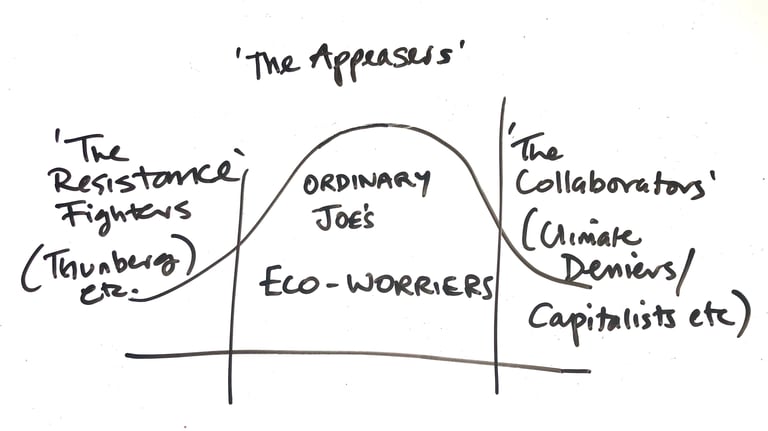
The Director retrieved the stubby pencil habitually tucked behind his ear and began to draw a curve like this:"Oh, oh! I know what this is!" exclaimed George, pleased with himself. "It's a boa constrictor eating an elephant!"
Stop Oil and Extinction Rebellion. They’re like freedom fighters taking the battle to the very cause of global warming: CO₂."
"Then, on the right here, we’ve got an equally small but far more powerful cabal of misguided, climate-denying capitalists. They’re more or less collaborating with an enemy bent on destroying the planet."
"They sound like Dr. No with LinkedIn Premium membership." chuckled George.
"Something like that," agreed D. "They’re the sort of people who see global warming less as an on-coming catastrophe and more an opportunity to make money. Tell them the world’s on fire, and they’ll try to sell us marshmallows."
George let out a sort of ‘sheesh’ noise.
"And then there are a lot of ordinary folk right here in the middle, who I’m calling the Eco-WORRIERS." The Director repeated the description slowly to make sure George appreciated his pun - ECO-WORRIERS - while gesturing toward the hump in the middle of the bell curve. "You know this lot, by which I mean me and you. You know, nice, middle-class tax-payers with serious jobs and a subscription to The Guardian. We aren’t stupid. We know something bad is happening to the weather, but we haven’t quite decided what we’re going to do about it. We haven’t yet quite decided how we are going to translate our anxiety into action."
"Yep, that pretty much sums me up,” confirmed George.
"Me too,” agreed D. "Let's be honest, the vast majority of us sit somewhere near the summit of this inertia curve. We know the battle lines are drawn and, from an emotional point of view, we side with the Resistance. On the other hand however, we haven’t yet decided to do anything about it. It all feels like too much of a faff. After all, if we were to take this seriously, we’d have to start giving up things like driving our car so much. I mean, who wants to catch a bus to work? And we might have to cut back on our avocado consumption because that’s a lot of carbon being wasted shipping them in from South Africa. And don't even think about giving up cheese! So, instead, we sit on the fence, unwilling to act until we absolutely have to. But guess what? THE FUCKING FENCE IS ON FIRE!"
George laughed. ”So we're climate In-Activists then?”
"You could say that."
"All this talk of resistance fighters reminds me of Star Wars, the Rebel Alliance versus the Galactic Empire." (George would find a popular movie to illustrate his point whenever possible.)
"You're not wrong," smiled D approvingly. "But this isn't A long time ago in a galaxy far, far away; this is right here on Earth, right now, and it's our planet that's about to be atomised by the Death Star, otherwise known as CO₂!"
“Are you serious?" asked George, unsure if D wasn’t over-exaggerating a tad.
"Yes George, I'm serious. I’m deadly serious."
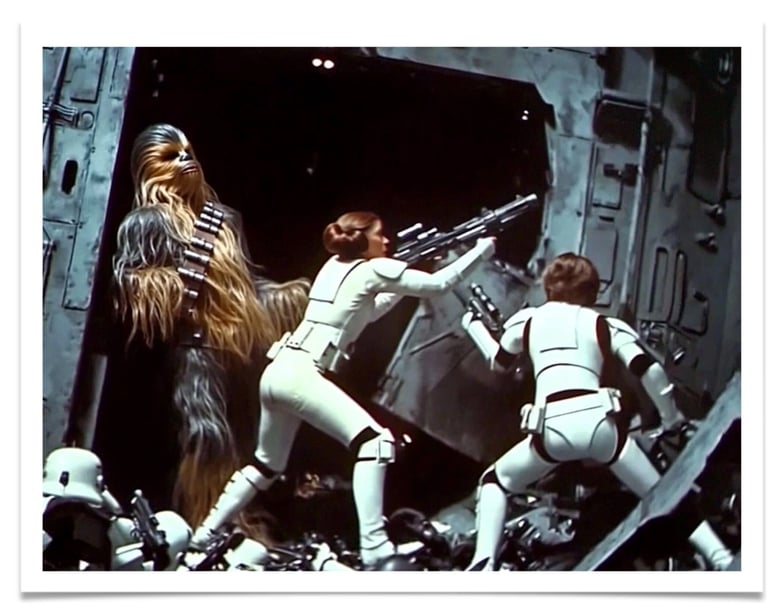
Seeing George's difficulty grasping the enormity of the situation, D searched for a better way to describe the scale of this danger. "You know that scene in Star Wars where Luke, Han, Leia, and Chewy are slowly being crushed in the trash compactor?"
"Classic scene." George smiled as he recalled it. "Though I think you're referring to Episode IV – A New Hope, sir."
“Whatever. The point is, we are now exactly at that same point of being crushed, right here on Earth. The walls are closing in, but this time, R2-D2 isn't going to come to our rescue. This time, whether we survive or not is up to us, and if we don't find an answer, and quickly, we're all going to be squashed like cockroaches."
This stark image wiped the smile off George's face.
Pleased to see he'd achieved his goal, D continued his exposition. "Sure, right now, we might take our reusable bags to the supermarket, and look for the recyclable icon on our yoghurt pots. We might even buy Fairtrade coffee and environmentally friendly laundry detergent, all of which helps us feel we're doing our bit. Yet, despite all that, it's hard not to feel like we ought to be doing more. Probably something far more drastic. But when we think about that, it seems complicated and inconvenient, so we put it off, ignore it and hope all this nasty business quietly goes away. Which, I'm afraid to say more or less makes us… Climate Appeasers."
George looked at the scribbles D was making while saying all this and mentally agreed that he did indeed sit somewhere in the middle of that curve, just as D had suggested.
"The thing is, you see, it's the eco-worriers who make up 90 per cent of the world's population. People like teachers, doctors, nurses, hard-working folk working in shops and factories. Older people, younger people. People who work for bosses, people who run their own businesses. They might even be top execs, like your character in the movie, George, who work for big corporations and drive electric cars. Most of the B Corp brigade will be in there, too, and maybe even a few conflicted CEOs of multinationals, still taking their hefty pay cheques while feeling uncomfortable but not knowing how to escape.
"And I desperately want people to understand that if all of us here in the middle got our act together and mobilised, we'd have far more power than all the climate deniers combined. And we wouldn't need to resort to physical combat or anything like that, there'd be no need to go Full Thunberg. If only we knew that, by working together to apply concerted pressure through our choices and behaviour, we could stop this climate crisis dead in its tracks. Collectively, we can change everything. And I mean everything. It's just that we don't know it yet. But we can, and will, if we, get our collective act together, and take responsibility."
The Director waved his arms in a circle to emphasise this point.
"We could stop CO2 emissions if we wanted to, but we don't, because, quite frankly, we're just too lazy and complacent. So we try not to think about it and wringing our hands for a bit, switch on the telly to take our minds off things and hope the whole thing will be sorted out by Season Three of whatever box-set we're watching.
"Don't get me wrong, I have the greatest respect for Greta Thunberg and her Extinction Rebellion allies," reassured D. "The Establishment detests her because they know she's on to them, and if they allow her to have her way, she'll stop them maximising their profits."
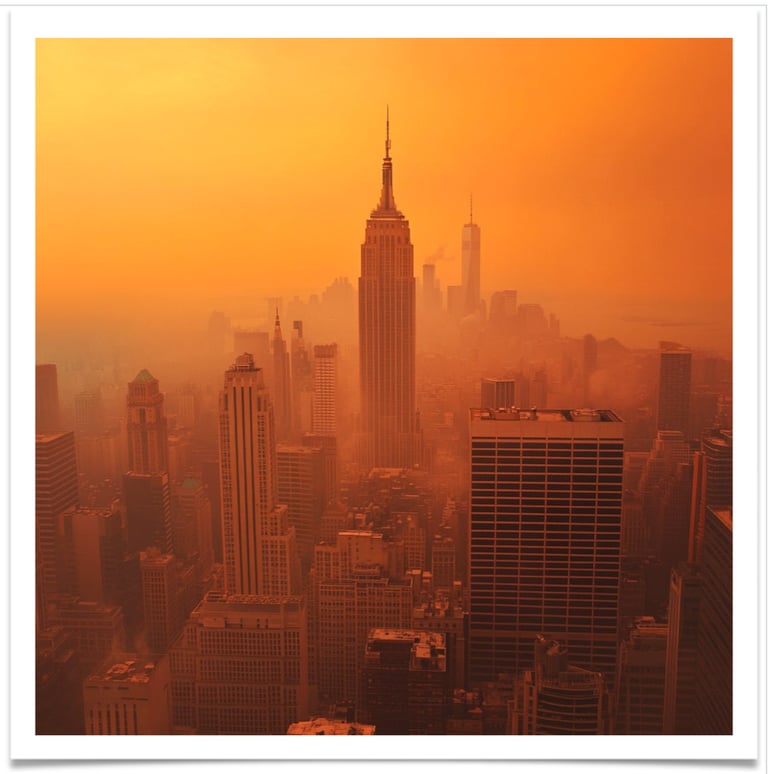
But every time there's an extreme weather event, like that time New York City turned orange, or when that inferno in Hawaii incinerated so many people, we start to suspect she might be right because these are not isolated incidents, but signs of a rapidly changing climate that demands our immediate and full attention.
We might even be prompted to look into what the Just Stop Oil people are so concerned about, and why they're willing to take the drastic action that will probably put them in jail. But it's a little bit too uncomfortable to think about, so we turn on the telly, all the while reassuring ourselves it's probably not as bad as they're making out. After all, we're all still here, aren't we?
"What's more, who will employ us if we go on Extinction Rebellion marches, having to call our boss on Monday morning to explain why we're in jail? Who's going to feed our kids and pay the mortgage? So it's best not to think about it and let that sleeping dog snooze a little longer.
"And we might also console ourselves that none of this could be as black and white as the Just Stop Oil fanatics make out. After all, plenty of intelligent, upstanding citizens are on the other side of the argument. Like the politicians and CEOs of multinational corporations who make up the Dragon Economy. They have important jobs, fly around in private jets, and earn a ton of money, so they must know what they're talking about. Not to mention the investment bankers and pension fund managers telling us not to worry about extremists like Greta, who, after all, is probably on the autistic spectrum anyway. And then, to seal the deal, they'll remind us how much we enjoy fast food, new cars, and foreign holidays, all of which would be a thing of the past if we started listening to the extremists. And every time Just Stop Oil blocks a road and prevents an ambulance from getting a critically ill patient to a hospital, it's an excellent opportunity to remind us that climate protesters are threatening our cherished way of life."
"Whoa!" George, recoiled. "That escalated fast!"
"Hang on a minute," replied D, not wanting George to reject his thesis so casually. "You might think this is a bit over-the-top, but the truth is, I'm only laying out the facts as they stand. Check them yourself if you don't believe me. Maybe ten years ago you could still find a scientist willing to claim climate change was a myth, but now it's pretty much an accepted fact, and climate deniers are about as credible as flat-earthers. So, if there's anything I've said that you disagree with, I'd love to hear it. You see, this isn't a political issue. The whole point of this movie is to demonstrate that climate change isn't about politics at all. It's a personal issue for each of us as individuals.
I'm not even trying to criticise the politicians or the capitalists, that's too easy. These Dragon Capitalists are just opportunists, taking advantage of this selfish streak we can’t let go of. No, the people I'm criticising in all this is ourselves; willing to turn a blind eye to our own selfish actions. Call it complacency, or wilful ignorance, our willingness to turn our backs on the problem.
The answer to solving global warming lies in the middle of this bell curve, where most of us live, and when we finally come to terms with that, we might just stand a chance of saving ourselves."
While saying all this, D continued to scribble with his stubby pencil.
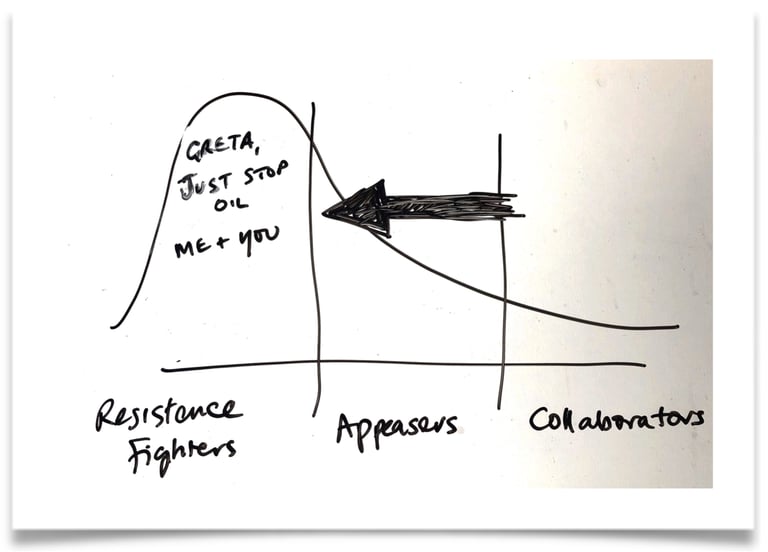
"So what we've got to do, and the point of this movie, is to shift the narrative like this. And, just like the Four Tops, we have to 'Reach Out' and encourage as many people as we can to join The Resistance.
The Director suddenly sang 'Reach Out' very loudly, which made George jump. He then drew a new curve with a big arrow pointing left to demonstrate his vision for escaping climate disaster.
"When we move the curve like this, we'll achieve critical mass, and when that happens, we'll change our future."
He now looked George in the eye and said earnestly, "The climate doesn't discriminate. It's a disaster that's coming for all of us, so we've all got to do our bit to stop it. We've all got to stop appeasing and start resisting."
"What's more, what comes after we put the brakes on global warming might turn out to be so much better than what we have now… But I'm getting ahead of myself, because nothing is possible unless we stop burning fossil fuels."
George studied the diagram carefully, stroking his chin a little in what he hoped looked like deep concentration.
"So, our first move in this war against CO₂ is to halt the enemy's advance, and maybe even push it back a little. We need to buy breathing space to figure out
what to do next. And we can't wait, because if we don't do something quickly, all of this will be academic, because we'll all be dead!"
As you probably guessed, the Director shouted that last bit for emphasis, making George jump. Seeing this, he then paused momentarily to collect his thoughts and to give George a breather.
"As I said earlier, I happen to think that despite being unbelievably stupid, humans are also incredibly clever, when we put our minds to it.
"When Kennedy said, We choose to go to the Moon in 1962, he didn't have the first clue how he would do it. But within eight years, Neil Armstrong was hopping around the lunar landscape, and Alan Shepard was hitting golf balls!"
"People thought Kennedy was crazy to make such an outlandish suggestion. Still, they got behind him anyway, and the combined weight and willpower of the American scientific community lined up to deliver on his promise. It just shows what we can do when we pull our fingers out."
George nodded to show he was impressed.
"Since then, we've managed to land a robot on an asteroid half a billion miles from Earth, collect rocks from its surface, and bring them back for us to look at in museums. So don't tell me we can't solve climate change. Reducing carbon emissions should be a piece of cake compared to gathering asteroid dust.
"But unfortunately, there's a hitch, because the question is less about whether we can solve the problem and more about whether we want to. Because right now, we all seem fond of the current system. If you ask me, we're in an abusive relationship, but can't face the thought of an alternative."
The Director finished his speech with a satisfied flourish, carefully laying the paper down in front of George and calmly pressing it flat.
"With me so far?" he asked.
"Yep." George had come through this part of the discussion relatively unhurt. "I'm a Resistance Fighter, ready to go to war. So where do I sign up?"
"That's the spirit! Let me show you."
1.3. Apparently, We DID Start The Fire
The Director leaned back, “But before I do that I want you to properly understand the problem, because unless we have a clear idea of what we're up against, we'll only end up addressing the symptoms, not the cause. Does that make sense?"
"I guess so," George was disappointed he wouldn't be getting a straightforward answer there and then, but shrugging in agreement just the same.
The Director leaned in closer to George, his eyes alight with zeal. "Great. So first off, I'm going to explain why we're so unwilling to get off our lazy backsides and do something about it."
At this point, D sprang out of his chair and began walking around the studio, hands clasped behind his back like a professor delivering a lecture to his undergraduates.
"Was it Schopenhauer or Plato who suggested that love was the defining characteristic of the human species?" asked D rhetorically.
George shrugged his shoulders. He hadn't heard of either of them, but it didn't sound like something Pluto would say (after all, Pluto was a dog), so he went for the Schopenhauer option.
"Never mind, it doesn't matter," D replied, fearing he might lose his audience if he didn't dumb it down a bit. "I think they both said it in one form or another and, in my humble opinion, they were both wrong.
“Anyone who’s owned a dog knows that its love for you is unconditional. Human love, on the other hand, usually boils down to vanity, infatuation, or insecurity. So no, love isn't a unique human emotion, but I'll tell you what is: hubris. Hubris is the thing that sets us apart.
We are the only species that thinks we’re superior to everything else. Come to think of it, the fact that humans assume we're the only species that feels love is a perfect example of our hubris. But I digress...
I'm also sure we're the only species that feels hate, but I'd contend that hubris is our defining and unique emotion. Hate will have us kill each other, but only hubris will have us kill ourselves.”
"That's a great quote! Who said that?" asked a curious George.
"I did!" replied D smugly. and then continued, "But it was Dostoevsky who said:
'Man, do not pride yourself on your superiority to the animals, for they are without sin, while you, with all your greatness, defile the earth and leave an ignoble trail behind you.'
"And I think it was Hubert Reeves who said: Man is the most insane species. He worships an invisible god and destroys visible nature. Unaware that the nature he's destroying is the god he worships; He was right about that, too".
George was impressed by how this revered old director could seemingly pull quotes from thin air, and wondered if he practised at home in front of a mirror.
"It wasn't an iceberg that sank the Titanic, George, but the hubris of a bunch of Edwardian engineers who thought they'd built an unsinkable ship. I guess the iceberg didn't get the memo.
"I first came across hubris when I was at RADA," continued D, now dreamily reminiscing, "The Greeks loved it; so many plays where humans challenge their gods and get their asses kicked. 'To those whom the Gods wish to destroy, they first make mad', as Euripides put it."
This was Greek to George, too, but he decided not to interrupt D's flow.
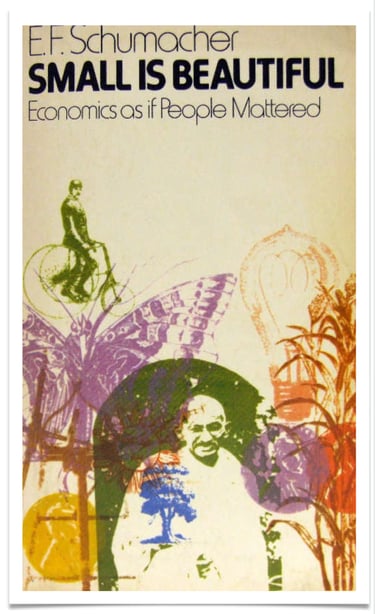
"We seem to have forgotten this. We don't respect nature, George. We've been abusing her for the last 200 years, and she's about to deliver some payback. We were warned about it as far back as the 1970s, when I first read "Small is Beautiful." E. F. Schumacher told us all about it, and we all bought his book, but we ignored him and kept sleepwalking towards the cliff edge, just as he had walked into war in 1939.
"In fact, it occurred to me the other day that the times we're living through now are very similar to the 1930s when Hitler was making a nuisance of himself. He was looking for a fight, but instead of standing up to him, Britain and France chose to appease him, which he took as an invitation to rebuild the German army, occupy the Rhineland and invade Czechoslovakia.
"We even looked the other way when he turned on the Jews, because we couldn't face the idea of another war. Appeasement never works, but we're doing it again. Only this time, our enemy isn't a testicularly challenged dictator but an angry ecosystem looking for payback. And it will swat us like a fly if we don't do something about it fast. And the crazy thing is, we're already at war! Hawaii, California, Canada, and the Greek Islands have all been hit, and if we don't do something right now, it'll soon be raining down fire on the rest of us.
"We ought to be throwing everything we have into a total war effort. Our leaders should be mobilising the whole of society, doing the equivalent of pulling up our iron railings and melting them down to build tanks and donating our pots and pans to be made into Spitfires. We should be Digging for Victory and joining the Home Guard. But instead, we sit on our arses, turn the TV channel to something less worrying and hope the problem quietly goes away.
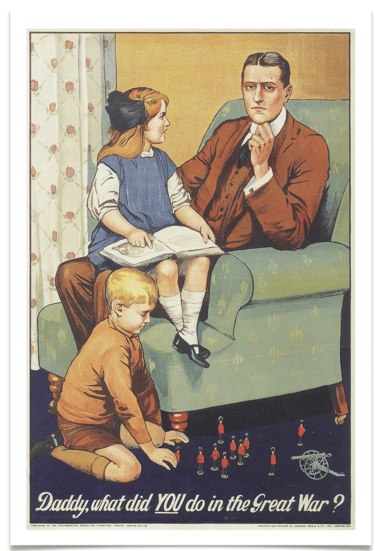
"We simply aren't concerned enough. But if we're too lazy or stupid to do it for ourselves, we should at least be doing it for our children and the magnificent planet we live on. It reminds me of that First World War recruitment poster on display at the Imperial War Museum in London called Daddy, What Did You Do in the Great War?"
It was designed to make fathers feel guilty about not joining up, and we need something similar now. We need to shame people into taking climate change seriously because, in 50 years, our children and grandchildren will look at the state of the world and rightfully ask us, their parents, what did you do to try to stop it? That is, if we are still alive in 50 years, which, given the direction the climate is heading in, we can't take for granted.
"Surely, if we're decent human beings with a scintilla of compassion for the generations following us, we should do everything in our power to prevent the awful things that will happen to them if we just do nothing. But what are we doing instead? We're sitting in front of our televisions thinking about where we want to go on holiday."
"I can't even watch the television these days," confessed George. "I used to love all those wildlife programmes, with that Brit guy, David Attenborough, up to his neck in bat dung."
"Guano!" exclaimed the Director.
"Gesundheit," replied George in earnest before continuing his anecdote, "but then, at the end of the show, Attenborough would tell us this or that species was now on the verge of extinction. It made me so sad I couldn't watch them anymore."
"That's exactly what I'm talking about.” D was touched by George's sensitivity, "But I'm getting off the subject… What I wanted to say was that, when it comes to the Climate War, Poland has already been overrun, and it won't be long before Britain has its Dunkirk moment all over again, by which time it'll all be too late. We'll be under-prepared, out-gunned and on the verge of defeat. Congratulations, you assholes!"
The Director sat down with a thud, 'assholes' left hanging in the air.
1.4: War: What Is It Good For?
After this outburst, D fell silent again, realising he'd become overwrought. He took a breath to calm himself. George sat quietly, too, looking into his plastic cup, wondering what was coming next.
"I hate it when I get this upset, but when I think about what's happening to our beautiful planet, I get so fucking angry."
"You're right to get angry," consoled George.
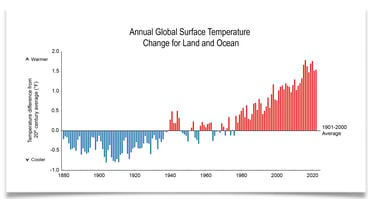
"Well, if anyone ought to be angry, it's you. As I've said, it was my generation of Boomers that caused this mess, and now we're just walking away, leaving you Gen X, Y and Zers to clean up. If it's not too late, that is." The Director then began to fumble in his pocket, looking for his battered old phone with the cracked screen. "Take a look at this, and if this doesn't scare the living crap out of you, nothing will." The Director offered George his phone. On the screen was a chart of average global temperatures from the last 100 years:
George examined the chart as D explained what he was looking at.
"Last year, the scientists looked at 34,000 climate studies, THIRTY-FOUR THOUSAND, and concluded, as if we didn't know already, that we are now suffering from intense heatwaves, droughts, wildfires, storms and floods and that much of this is irreversible. FUN FACT: The past 12 months were the hottest year in at least two million years. They also say the window of opportunity for action to prevent disaster is 'brief and closing'. "Brief and closing," reiterated D for effect.
"And the heat and the carbon dioxide aren't the worst of it," he said, his tone increasingly resigned. "The zombie apocalypse will have nothing on what's coming. Before we die of heat exhaustion, there's going to be societal collapse. Water will be scarce, so we'll fight each other for it. There's going to be massive refugee displacement, which means a lot more boats coming over the English Channel and a lot more so-called illegals climbing over Trump's Wall. Agriculture will fail, food will be unaffordable, and energy will only be for the very rich, who'll guard it with their private militia.
"And here's the irony: in this beautiful capitalist world of the near future, which the politicians seem so keen to sell us, we won't be buying new cars or going on exotic foreign holidays. No, no. We'll be living in fear and scratching for food in the dirt. That, my friend, is the hubris I'm talking about. We're like that ostrich with its head in the sand, only it's worse; our head's in the sand, our ass is pointing at the sky, and there's a firework sticking out of it, burning like a Roman candle. Am I painting a picture of the mess we've created for ourselves?"
George nodded and slumped his shoulders, trying hard not to summon that particular image.
"And that's why I made this movie. Because unless we all do as much as we can, not next year or next month, but RIGHT NOW, we're all going to die a premature and unnecessary death.
"I know people will think I'm being an extremist. They won't want to listen to a crazy old man overreacting to something that will never happen. But that's what they said in 1937. Right now, there are three big truths people are unwilling to confront."
George felt obliged to ask, "What are they?" while simultaneously sensing he didn't really want to know the answer.
"First," D’s voice dropping an octave, "we're facing an unavoidable crisis that will create chaos and anarchy. Second, capitalism is the primary cause of this crisis, and to prevent it, we will need to radically change our lifestyles. If you think about it, climate change is just a symptom of capitalism, but this is what we're unwilling to confront because it seems so big and uncontrollable. And third, we don't want to give up our dreams of new cars and foreign holidays."
'Jesus!' was all George could think of to say as he mulled over this analysis.
"And why are we going to let ourselves die?" The Director, was on a roll. "Not because we don't know what to do. We know why the climate is out of control, and we know what's causing it, so why don't we do something about it?"
Bewildered, George just shook his head.
"Because we're asleep at the wheel, AND IT'S TIME WE WOKE UP!"
There was another of those moments of silence as D composed himself again.
"And that's the purpose of my film… It’s my attempt to wake us up. Woke isn't just about Black Lives Matter or transgender rights; it's literally about waking up to what we need to do to stop global warming."
The Director then said in a slow and determined voice: "WE, NEED, TO, WAKE, THE, FUCK, UP!"
This certainly woke George up. He felt like a drunk being shaken by the shoulders and being told to sober up. But he still wasn't sure where this conversation was going, and the shouting wasn't exactly helping. Yet, on the other hand, he felt he was starting to come to his senses, if only a little.
Unsure of what to say next, the two sat quietly, looking into their empty plastic cups again.
After perhaps a minute, D decided to change the subject: "We're like that frog they put in a pan of hot water.”
"We're eating frog's legs now?" George was trying to lighten the mood.
"Not exactly," D laughed, "Too much garlic for me; gives me heartburn. No, I was thinking more about why artists like us must use our imagination to make the world realise we're being boiled alive. We need to wake them up before it's too late."
"I understand," George could see that he needed to support this passionate old filmmaking legend in his mission. "We've got to shake people awake. But what do we tell them once we've done that? We can tell them they're in danger, but they'll then need to know what they can do about it. This is the bit that's missing for me. I now understand why you made the film and who you made it for, and you've explained how we're just snoozing in front of the TV while our house is on fire. But what's the alternative? What do you want me to do?"
The Director tried not to look surprised. This was the most coherent sentence he'd heard George utter in the past six months: a perfect summary of D's theses to date. George had confronted the danger, acknowledged its cause, and now seemed willing to take action. The Director felt a flicker of optimism.
“That’s the spirit George! And remember, didn’t the Death Star have a vital weakness in its design?”
“That’s right Sir, a small thermal exhaust port, 2 meters wide, located on the surface of the station.” George was delighted to show off his extensive knowledge of Star Wars.
“Well, there’s a flaw in the design of Capitalism too and if we ALL learn how to find it, we can BLOW THIS WHOLE FUCKING SYSTEM UP TOO!… But I’ll come to that later…”
“Ooooh - foreshadowing!” said George in delight.
Perhaps there was still hope… A New Hope.
Chapter One: The Wrap Party (4pm)